Is plug-in solar safe? The real risks and how kits handle them
The three real hazards of balcony solar are a live plug, an overloaded circuit and power during an outage. How certified kits handle each, and what to check.
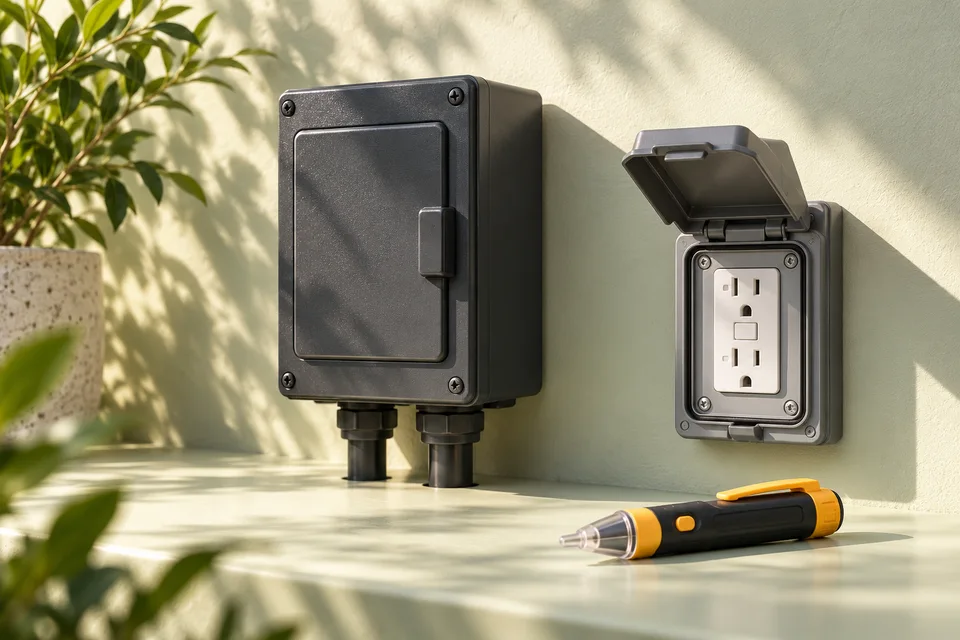
Plug-in solar is low-voltage and small, but it does something no other appliance does: it pushes power into your home wiring instead of drawing from it. That creates three specific risks. A well-designed, certified kit on a suitable circuit handles all three. A cheap kit on the wrong circuit may not.
Before you plug anything in: use equipment listed for plug-in solar, keep it within your state’s wattage cap, and have the outlet, circuit and required protection checked against the product’s installation instructions. A legal wattage limit or an apparently unused outlet does not establish electrical safety.
Risk 1: a live plug
A normal appliance plug is dead when you pull it out. A solar kit’s plug is connected to a power source, so if the microinverter kept producing when unplugged, the exposed pins could be live. The Clean Energy States Alliance guidebook calls this “touch safety.”
Loss-of-grid shutoff is essential, but it is not by itself proof that exposed plug pins are safe to touch. UL Solutions distinguishes ordinary grid-interactive inverter certification from plug-in contact-safety protection. Use equipment listed for plug-in service and follow its shutdown and disconnection instructions. Maryland’s Public Service Commission warns about shock risk from the energized output cord and plug; do not assume an unplugged solar connector is immediately safe to touch.
Risk 2: overloading a circuit
This is the risk electricians raise most often, and it is less intuitive. Your breaker protects the wire by measuring current coming from the panel. Solar adds current partway down the circuit, which the breaker cannot see.
Two sources. One section of wire.
The 15 A breaker sees only the grid's 12 A. A downstream section can carry 22 A, exceeding its 15 A rating without tripping that breaker.
If the solar outlet sits between the breaker and a big load, the wire beyond the solar outlet can carry grid current plus solar current. The guidebook calls this “breaker masking.” A 1,200 W system supplies 10 A at 120 V, but that does not create spare capacity on a 15 A or 20 A circuit: the grid can supply additional current at the same time. Staying below a state wattage cap does not establish that a shared circuit is safe.
What reduces the risk:
- Check the circuit and the listing together. Have a licensed electrician assess the circuit, existing loads, outlet and protective devices against the kit’s listed installation instructions. An outlet that appears lightly used does not prove that its wiring is protected against combined current.
- Do not use size alone as the safety check. Smaller output reduces the added current, but does not eliminate hidden overload or GFCI-compatibility risks.
- Use the protection the listed system requires. UL Solutions describes dedicated circuits, coordinated overcurrent protection, power control systems and bidirectional GFCI protection as possible engineered solutions. Follow the actual product listing and local requirements; do not assume every kit can use any ordinary outlet.
- Follow your state’s extra rules. Maine requires a licensed electrician above 420 W. Vermont lets landlords require that electrical work be done by a licensed electrician at the tenant’s cost.
Risk 3: power during an outage
When the grid goes down, line workers expect the wires to be dead. A device that keeps feeding power out of your home, called islanding, could injure them. Every state plug-in law we reviewed requires a feature that stops the system from energizing the building during an outage. Vermont and Connecticut go further and require compliance with IEEE 1547, the interconnection standard used for rooftop inverters.
- Sunlight → DC
Panels
Photovoltaic cells generate direct current.
- DC → AC
Microinverter
Converts output to grid-synchronized alternating current.
- Into home wiring
Listed connection
The outlet and circuit must meet the system’s listing.
- Used at home
Appliances
Output offsets demand while appliances are running.
When the grid goes downA qualifying grid-tied system stops energizing the grid. It is not backup power unless the product provides a separate supported backup function.
Mounting is a safety issue too
Commenters in plug-in solar discussions worry about panels falling from railings, and they are right to. A 400 W panel weighs around 40 to 50 lb and acts like a sail in wind. Use the brackets made for your railing type, tie every clamp to a structural member, and never zip-tie panels to a railing. Check your building rules, because a falling panel injures people below.
Certification: what to look for
Look for a listing mark from a nationally recognized testing laboratory (NRTL), such as UL, CSA, Intertek (ETL) or TÜV, and check that it covers the whole system or the microinverter as plug-in equipment, not just the panels. Vermont and New Jersey name UL 3700 specifically. Connecticut names UL 1741, the long-standing inverter standard. Read our UL 3700 explainer for which products had certification as of our last check.
When to wait
In New Hampshire, the City of Dover’s electrical inspector urged residents to hold off until the state Department of Energy certifies a recognized standard. That advice applies more broadly: if your state has no plug-in law, or the law is not yet in effect, the safest path is to wait or to ask your utility and a licensed electrician directly.
Common questions
Can a plug-in solar kit electrocute a utility worker?
Not if it is a proper grid-tied kit. The microinverter must shut off when it loses grid voltage, and every state plug-in law requires that feature. This is the same anti-islanding function rooftop inverters have used for decades.
Can I plug it into an extension cord or power strip?
No. Plug the kit directly into a wall outlet. Extension cords and power strips add connections and are not rated for a source feeding power back.
Do I need a GFCI outlet?
It depends on the product and the location. Outdoor and balcony outlets usually require GFCI protection under the electrical code anyway. The policymakers' guidebook flags possible interference between plug-in systems and GFCI outlets, so follow the kit maker's instructions and its certification listing.
Is an uncertified kit from an online marketplace okay under 400 W?
Virginia, Maryland and New Jersey exempt very small devices (391 W or 400 W and below) from some listing requirements, but that is a legal threshold, not a safety guarantee. We recommend a kit listed by a nationally recognized testing lab at any size.
Sources
- UL Solutions, Safety Considerations for Plug-In Photovoltaic Systems, July 1, 2026
- pv magazine, A guidebook on plug-in balcony solar for U.S. policymakers (Clean Energy States Alliance), Jan 14, 2026
- CleanTechnica (UL Solutions release), UL debuts testing and certification framework for plug-in solar, Jan 8, 2026
- Third Act, Balcony solar update, Jul 10, 2026
- Maryland PSC, Balcony Solar
- City of Dover, NH, Energy Commission and electrical inspector urge caution, Sep 2026
- Vermont Act 149 of 2026, as enacted
- Connecticut Public Act 26-127
- r/technology discussion of plug-in solar safety concerns