Balcony solar orientation, tilt and shade: how much each costs you
Compare modeled sunlight at different balcony tilts and directions, understand shading limits and use location-specific production estimates.
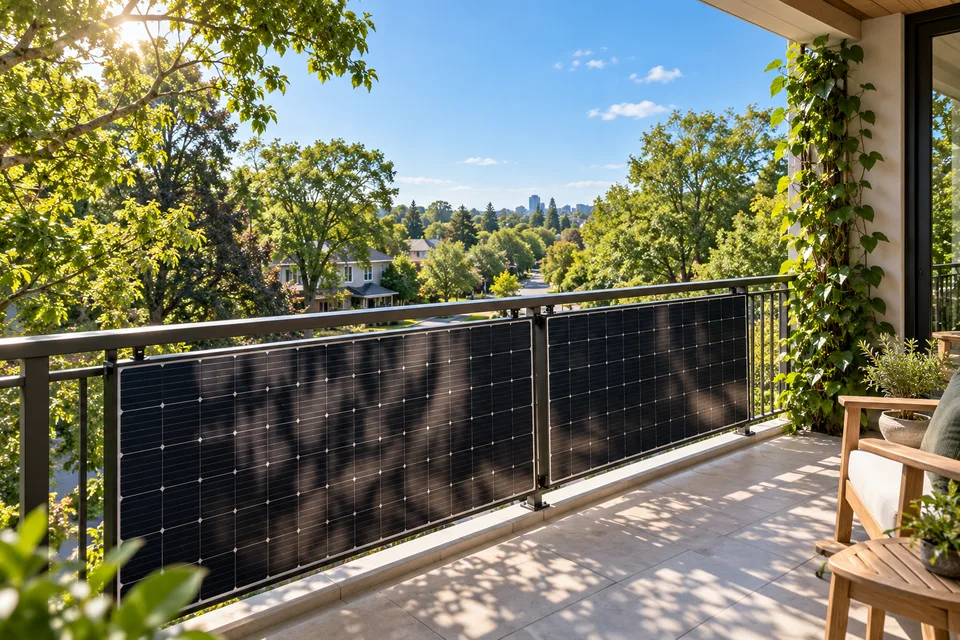
On a balcony you rarely get to pick the ideal angle. The railing decides. So the useful question is how much each compromise costs. We modeled every common combination of tilt and facing so you can see it at a glance.
What the numbers say
For the Baltimore reference location, yearly sunlight relative to a 20° south-facing surface is:
- Vertical south: 72%.
- Vertical southeast / southwest average: 68%.
- Vertical east / west average: 53%.
- South at 35°: 104%; south at 60°: 98%.
- Vertical north: 22%.
These are sunlight ratios, not final AC energy or savings ratios. Temperature, inverter limits and the amount used at home affect those results separately. Other cities have different ratios; use the state-specific calculator for comparisons.
Location changes the picture
Sun angle and the balance of direct and diffuse light vary with location. The calculator uses separate PVGIS ERA5 weather profiles for one representative city in each state and Washington DC; it does not interpolate between three cities or treat latitude alone as a climate model.
Shade
Shade costs more than its share. A shadow over part of a panel can cut that panel’s output sharply, because the cells are wired in series. Rules of thumb:
- A railing post, a neighbor’s balcony slab or a tree that covers the panel for a few hours a day can cut yearly output by a quarter or more.
- Panels with more bypass diodes and one microinverter per panel limit the damage to the shaded panel only.
- Watch where the shadows fall at 10 a.m., noon and 3 p.m. before choosing where to hang panels. Winter shadows are longer.
Ways to win energy back
- Use a tilting bracket if your building rules allow it. Compare the allowed angles using your state in the calculator.
- Mount on the sunniest part of the railing, away from the slab above.
- Keep the panels clean. Balcony panels collect dust and pollen.
- Split panels across two faces of a corner balcony to catch morning and afternoon sun, if each panel has its own microinverter.
How we modeled it
We use pvlib 0.16.1 with the Perez sky model and ground reflectance 0.2, using 8,760-hour PVGIS ERA5 typical-year weather for each representative city. Each chart value is yearly sunlight on the tilted surface divided by sunlight on a 20° south-facing surface at the same city. Paired directions in the chart are averages; the calculator offers eight individual directions. The scripts, data and limitations are described on our orientation data page and methodology page.
Common questions
Is vertical balcony solar worth it?
It can be, depending on location, shade, household use and total installation cost. Compare vertical and tilted setups in the calculator; the mounting must be permitted by your building.
Do east or west facing balcony panels work?
Yes. East and west have different production timing and weather exposure. Our calculator models them separately using the representative location’s typical-year weather.
Does a north-facing balcony work?
It can generate from diffuse and reflected light, but typically receives less sunlight. Compare your location and allowed mounting options before buying.